
Education
People with disability have a right to education without discrimination.
(Article 24, Convention on the Rights of Persons with Disabilities).
School and Post-school education should provide good opportunities for social and academic learning for ALL students.

It can be hard for people with intellectual and other developmental disabilities to find a school they enjoy, where they have friends and are academically challenged with the right supports.
Research shows that one of the best ways to foster every aspect of your child’s learning and development is to enrol them in an inclusive school environment where they can learn with and alongside other students both with and without disability. Some families may feel their child is best supported in a segregated setting. DDWA recognises that there are still mainstream schools in Western Australia where there is not yet enough knowledge or experience in accommodating the needs of students with disability. We're here to support your choice.
The information below is designed to help people understand what education options are available to them and how to get support should there be difficulties.
Individual Education Advocacy
DDWA is able to offer information, guidance, support and problem-solving strategies over the phone and to suggest referrals to other services who are best experienced to help with further advocacy.
You can contact the organisations below to discuss your specific circumstances:
People with Disabilities WA (Perth metro and regional)
Phone: 6243 6948
https://pwdwa.org/
MIDLAS (North-east region of Perth)
Phone: 9250 2123
https://www.midlas.org.au/services/
Sussex St Community Law Service (Perth, Perth mid-west, Goldfields/Esperance and Great Southern)
Phone: 6253 9500
https://www.sscls.asn.au/individual-disability-advocacy-service
Uniting (Your Say)
Phone: 1300 663 298
https://unitingwa.org.au/services/ndis-advocacy/
Advocacy WA (South-west region of WA)</p
https://www.advocacywa.org.au/
Please also see information about understanding the complaints or concerns process for the:
Education Department of WA
https://www.education.wa.edu.au/complaints
Private Schools (incl Catholic & Independent)
https://yla.org.au/wa/topics/school/private-schools/
DDWA Resources

Off to School

An included life

Supporting School-age Children with Fetal Alcohol Spectrum Disorder
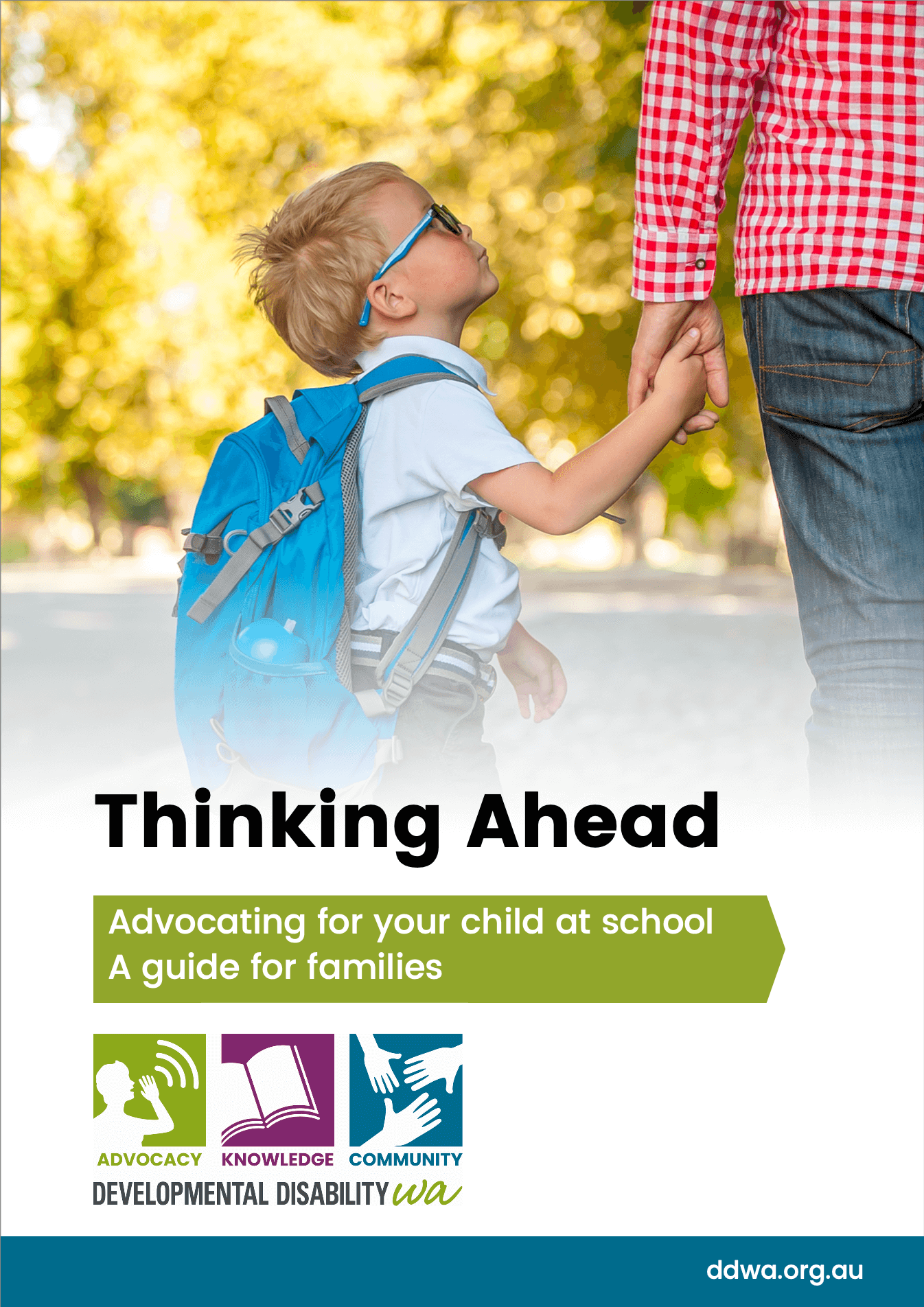
Thinking Ahead

Thriving in Regular Schools

Teaching Students with Disabilities

Autism Parents' Handbook 2025 e-Update

Beyond Complaints - A Report on an Education Advocacy Service for Western Australia

More Information
Suspensions in Western Australian public schools- A guide for parents and caregivers of neurodivergent children*
This guide was compiled by Peta Drury, mum to a child living with ADHD and giftedness, and passionate parent supporter. This guide is not intended as legal advice. If you are in any doubt as to you or your child's rights, please seek independent legal advice. This guide does not apply to non-government schools.
*Neurodiverse conditions include autism, dyspraxia, dyslexia, dyscalculia. ADHD and Tourette's syndrome among others. The accuracy of this information was verified as of April 2024.
Post-School Resources for Young People with Disability: Training and Career Development
Here are a range of resources and event information to support young people with disability as they plan for training and career pathways after school. The information includes transition planning tools, career pathway guides, and education standards. Find out more at the links below:
- Join the conversation about post-school options. Talking to your child about their future? The Department of Education holds free, family events to help you and your child learn about post-school options and career pathways, in Perth, surrounds, and regional areas.
- https://www.education.wa.edu.au/careerconversationevents
- Career pathway information for young people with disability – Information for parents and carers, with links to various resources.
- https://www.education.wa.edu.au/dl/ok9v70ev
- A booklet providing information about finishing school and starting the next part of life – a time full of possibilities and opportunities.
- https://content.yourcareer.gov.au/sites/default/files/2024-02/2024%20Support%20for%20young%20people%20with%20disability%20-%20Web.pdf
- Transition planning for the future – guiding questions for parents and carers.
- https://www.education.wa.edu.au/dl/nmdgv1g
- A transition planning questionnaire for parents to help set goals and plan for their child's future.
- https://www.education.wa.edu.au/dl/o1rg8op
Disability Standards for Education - Australia
A practical guide for individuals, families and communities -Explains the standards of providing education for students with disabilities and what parents/guardians can expect for supports for their children in school.
nccd.edu.au/disability-standards-education
Disability Standards - Information resources for students with disability and their caregivers
The Australian Government worked with Children and Young People with Disability Australia to co-design information resources to help students with disability and their caregivers understand their rights under the Disability Standards for Education 2005.
Your Career - National Careers Institute
The National Careers Institute (NCI) dewr.gov.au/nci has developed this resource for young people with disability and their support networks. It explains some of the support and information available to young people with disability about work, study and training options after school.
This guide sits alongside the more detailed School Leavers Information Kit (SLIK) for young people aged 15 to 24 yourcareer.gov.au/school-leavers support/school-leavers-information-kit. The SLIK explains the different paths you can take through education, training and work.
In addition, you may find extra information in our Support for regional, rural and remote young people booklet and the Aboriginal and Torres Strait Islander School Leavers information page and Information Kit.
Australian Alliance for Inclusive Education - All Means All – for Educators
Provides concise information and toolkits about inclusive education and class culture; why include, supporting peer connection, the role of education assistants, and behaviour support.
PDA strategies to try at school by Heidi Brandis
Pathological Demand Avoidance (PDA) is a profile that describes those whose main characteristic is to avoid everyday demands and expectations to an extreme extent (from pdasociety.org.uk)
Heidi Brandis, author of the Autism Parent's Handbook, has developed a resource for Educators about supporting autistic students with a PDA profile. You can download the PDF here: PDA Support Strategies at School (PDA Training Australia).
Visit PDA Training Australia Facebook page HERE.
DDWA Services


Information, Guidance and Support
We provide information to people with disability, family members, carers and supporters, across Life Transition Stages to help you to Self-Advocate and Navigate Systems including:
- getting a diagnosis
- navigating disability services and the NDIS
- starting school and negotiating the school journey
- making friends
- turning 18
- getting a job
- staying safe and healthy
- starting a relationship
We also provide information and guidance to support you to self-advocate in any area where laws have an impact on the person with disability's life, such as information about State Administrative Tribunal (SAT) in respect to Guardianship and Administration matters, Child Protection, Enduring Power of Attorney, Advanced Health Directives and preparing for illness/death of a parent.
For a full list of the areas we cover, see our Focus Areas Page Here.
Cost – This is a free service.

Side by Side Peer Community
Side by Side began as a project in 2012 for families experiencing behaviour which could be seen as challenging. The project connects families experiencing challenging behaviour with other families though a supported peer group, an active online community and in person events. Side by Side is a safe place to receive support and help each other.
For information and how to join, contact:
Bronwyn Pike: bronwyn.pike@ddwa.org.au, or
Maggie Visser: maggie.visser@ddwa.org.au
Website: ddwa.org.au/services/family-peer-support-side-by-side
Independent Support Coordination
DDWA are a registered NDIS provider for support coordination.
We can support you to fully understand and implement the funded supports and services in your NDIS plan.
This service is currently at FULL CAPACITY.
FAQ's

How do I choose the right school for my child ?
- « Previous
- 1
- 2